HANDS® creating innovative
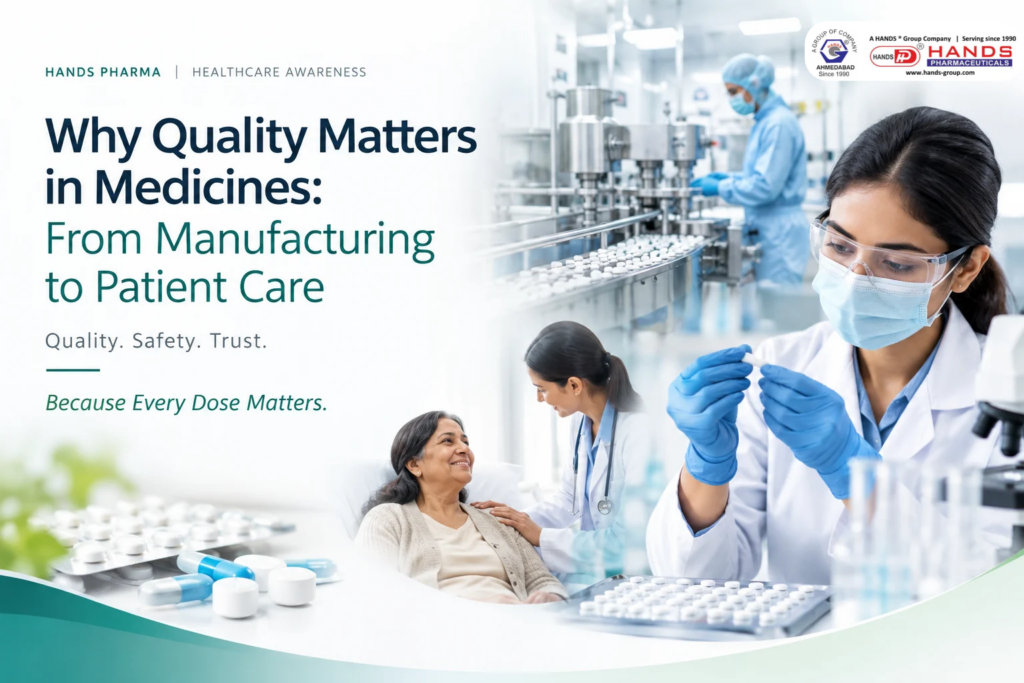
Medicines play a role in preventing, managing and treating diseases. However the effectiveness of medicine depends not on medicines intended purpose but also on medicines quality, safety and consistency. From sourcing materials to manufacturing, packaging, storage and distribution every stage of the pharmaceutical process contributes to the quality of medicine that reaches patients.
Medicine quality is more than a manufacturing requirement. Medicine quality is a responsibility towards patients and, toward healthcare professionals who depend on pharmaceutical products.
Understanding why pharmaceutical quality matters helps highlight the importance of quality control, good manufacturing practices, proper storage and responsible distribution. These practices protect well-being.
Pharmaceutical quality refers to a medicine’s ability to meet established standards for identity, strength, purity, safety, and performance.
A quality medicine should contain the intended ingredients in the specified amounts and meet applicable standards throughout its shelf life when stored as directed.
Poor-quality medicines may contain incorrect amounts of active ingredients, unwanted contaminants, or ingredients that have degraded due to improper manufacturing or storage. Such problems can compromise treatment and may expose patients to unnecessary risks.
For this reason, pharmaceutical companies must follow applicable regulatory requirements and maintain documented quality systems throughout the product lifecycle.
The quality of a finished medicine starts with the materials used to manufacture it. Active pharmaceutical ingredients (APIs), excipients, and other materials must meet appropriate specifications before they enter production.
Important quality measures include:
Supplier qualification: Working with approved and appropriately assessed suppliers.
Material testing: Verifying that raw materials meet established specifications.
Documentation and traceability: Maintaining records of material sources, test results, and batch details.
Controlled storage: Protecting materials from unsuitable temperature, humidity, light, and contamination.
These steps help reduce the risk of unsuitable materials entering the manufacturing process.
Good Manufacturing Practices (GMP) provide a framework for producing medicines consistently according to established quality standards.
GMP covers more than the operation of manufacturing equipment. It also includes personnel training, facility hygiene, equipment maintenance, documentation, process controls, and the prevention of contamination and mixups.
Key elements of pharmaceutical manufacturing quality include:
Validated processes: Manufacturing procedures should be appropriately validated or qualified to demonstrate that they can consistently achieve the intended results.
Trained personnel: Employees must understand their responsibilities and follow approved procedures.
Equipment maintenance: Equipment must be suitable for its purpose, properly maintained, and appropriately cleaned.
Accurate documentation: Manufacturing activities and deviations must be recorded to support traceability, investigation, and accountability.
By maintaining these controls, pharmaceutical manufacturers can help ensure that each batch meets its defined quality requirements.
Quality control (QC) and quality assurance (QA) are closely related, but they perform different roles.
Quality control focuses on sampling, testing, and checking materials, in-process products, and finished medicines against established specifications.
Quality assurance takes a broader approach. It covers the systems, procedures, audits, training, documentation, and oversight designed to build quality into the manufacturing process.
Together, these functions help identify potential problems, prevent recurring defects, and ensure that decisions about product release are supported by appropriate evidence.
Depending on the product and applicable requirements, quality checks may include:
Identification and assay of active ingredients.
Tests for impurities and contaminants.
Microbiological testing where applicable.
Dissolution or other performance tests where required.
Stability studies to establish shelf life and suitable storage conditions.
Packaging and labelling verification.
Not every test applies to every medicine. Testing requirements depend on the product, its specifications, and relevant regulations.
Even a medicine manufactured to high standards can deteriorate if it is packaged, labelled, transported, or stored incorrectly.
Packaging helps protect products from environmental exposure, contamination, and physical damage. Labelling provides essential information, including dosage instructions, batch identification, expiry date, and storage conditions.
Proper storage and distribution help preserve product quality until the medicine reaches the patient.
Pharmaceutical companies and distribution partners should pay attention to:
Temperature and humidity requirements.
Appropriate packaging and handling.
Batch numbers and expiry dates.
Stock rotation and inventory management.
Temperature monitoring for products requiring controlled conditions.
Traceability and appropriate management of returned or potentially compromised products.
These measures help maintain the quality of medicines beyond the manufacturing facility.
The ultimate purpose of pharmaceutical quality systems is to help ensure that patients receive medicines that meet the required standards.
Poor-quality medicines can lead to serious consequences, depending on the nature of the defect. For example, incorrect ingredient strength may affect treatment, contamination may create additional health risks, and product degradation may reduce quality or performance.
Consistent quality helps healthcare professionals make treatment decisions with greater confidence in the medicines they prescribe or administer.
It also supports patient trust in pharmaceutical products and the healthcare system.
However, medicine quality alone cannot guarantee a successful treatment outcome. Results also depend on factors such as the patient’s condition, correct prescribing, appropriate use, adherence to instructions, and clinical monitoring.
Pharmaceutical quality is supported by regulatory standards and ongoing oversight. Manufacturers must comply with the requirements applicable to their products, manufacturing activities, and markets.
Quality management should not stop when a batch is released. Companies also need systems for investigating deviations, managing complaints, evaluating potential quality defects, and implementing corrective and preventive actions (CAPA).
Where necessary, quality issues may require product recalls or notifications to the relevant authorities.
Continuous improvement helps organisations learn from investigations, strengthen processes, and reduce the likelihood of similar problems occurring again.
A strong quality culture encourages employees to report concerns, follow procedures, and prioritise patient safety over production convenience.
Healthcare providers, distributors, and other pharmaceutical partners should consider quality systems when evaluating manufacturers and suppliers.
Useful factors to review include:
Applicable manufacturing licences and regulatory authorisations.
Compliance with relevant GMP requirements.
Quality documentation and batch traceability.
Appropriate testing and stability data.
Complain handling and recall procedures.
Product specific storage and distribution requirements.
These checks help organisations make informed decisions when selecting pharmaceutical partners.
Patients should obtain medicines through authorised pharmacies or other legally approved channels and follow the instructions provided by their healthcare professionals and product labels.